Download PDF Electrical Machines, Drives, and Power Systems (4th Edition), by Theodore Wildi
When a lot more, checking out practice will constantly give beneficial advantages for you. You may not require to invest several times to check out the e-book Electrical Machines, Drives, And Power Systems (4th Edition), By Theodore Wildi Simply alloted numerous times in our extra or free times while having meal or in your workplace to review. This Electrical Machines, Drives, And Power Systems (4th Edition), By Theodore Wildi will reveal you brand-new thing that you can do now. It will help you to boost the high quality of your life. Occasion it is merely an enjoyable e-book Electrical Machines, Drives, And Power Systems (4th Edition), By Theodore Wildi, you could be healthier and also more fun to appreciate reading.
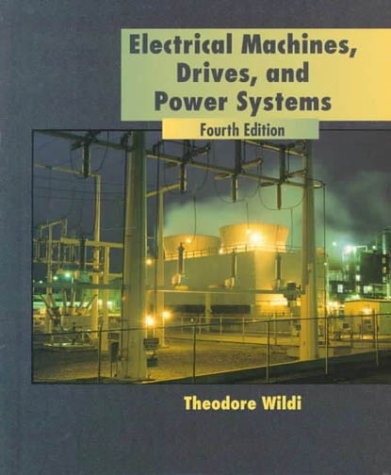
Electrical Machines, Drives, and Power Systems (4th Edition), by Theodore Wildi

Download PDF Electrical Machines, Drives, and Power Systems (4th Edition), by Theodore Wildi
Electrical Machines, Drives, And Power Systems (4th Edition), By Theodore Wildi When creating can transform your life, when writing can enhance you by providing much cash, why do not you try it? Are you still quite confused of where understanding? Do you still have no concept with just what you are going to write? Now, you will certainly require reading Electrical Machines, Drives, And Power Systems (4th Edition), By Theodore Wildi An excellent author is a great user at once. You can specify exactly how you write depending upon what publications to review. This Electrical Machines, Drives, And Power Systems (4th Edition), By Theodore Wildi could aid you to resolve the issue. It can be among the best resources to develop your composing ability.
Poses now this Electrical Machines, Drives, And Power Systems (4th Edition), By Theodore Wildi as one of your book collection! However, it is not in your cabinet collections. Why? This is the book Electrical Machines, Drives, And Power Systems (4th Edition), By Theodore Wildi that is offered in soft data. You can download and install the soft file of this magnificent book Electrical Machines, Drives, And Power Systems (4th Edition), By Theodore Wildi currently as well as in the web link supplied. Yeah, various with the other people that try to find book Electrical Machines, Drives, And Power Systems (4th Edition), By Theodore Wildi outside, you could obtain simpler to present this book. When some people still walk into the establishment as well as look the book Electrical Machines, Drives, And Power Systems (4th Edition), By Theodore Wildi, you are below only remain on your seat and obtain the book Electrical Machines, Drives, And Power Systems (4th Edition), By Theodore Wildi.
While the other people in the establishment, they are unsure to locate this Electrical Machines, Drives, And Power Systems (4th Edition), By Theodore Wildi directly. It might require even more times to go shop by shop. This is why we intend you this site. We will supply the very best means as well as recommendation to obtain guide Electrical Machines, Drives, And Power Systems (4th Edition), By Theodore Wildi Also this is soft file book, it will certainly be simplicity to lug Electrical Machines, Drives, And Power Systems (4th Edition), By Theodore Wildi anywhere or conserve in the house. The distinction is that you may not need relocate guide Electrical Machines, Drives, And Power Systems (4th Edition), By Theodore Wildi place to area. You may require only copy to the various other devices.
Now, reading this spectacular Electrical Machines, Drives, And Power Systems (4th Edition), By Theodore Wildi will certainly be simpler unless you obtain download the soft file below. Just here! By clicking the link to download and install Electrical Machines, Drives, And Power Systems (4th Edition), By Theodore Wildi, you can begin to get the book for your own. Be the very first proprietor of this soft file book Electrical Machines, Drives, And Power Systems (4th Edition), By Theodore Wildi Make distinction for the others and obtain the very first to step forward for Electrical Machines, Drives, And Power Systems (4th Edition), By Theodore Wildi Present moment!
For one-semester, undergraduate-level courses in Motor Controls, Electric Machines, Power Electronics, and Electric Power.This best-selling text employs a theoretical, practical, multidisciplinary approach to provide introductory students with a broad understanding of modern electric power. The scope of the book reflects the rapid changes that have occurred in power technology over the past few years--allowing the entrance of power electronics into every facet of industrial drives, and expanding the field to open more career opportunities.
- Sales Rank: #306267 in Books
- Published on: 1999-08-05
- Ingredients: Example Ingredients
- Original language: English
- Number of items: 1
- Dimensions: 9.75" h x 8.00" w x 1.75" l, 1.10 pounds
- Binding: Hardcover
- 858 pages
From the Publisher
This best-selling text employs a theoretical, practical, multidisciplinary approach to provide introductory students with a broad understanding of modern electric power. The scope of the book, now in its Third Edition, has been expanded to reflect the rapid changes that have occurred in power technology during the past five years.
From the Back Cover
This comprehensive and coherent coverage of electrical machines, drives, and power systems serves as an on-the-job reference guide for electrical engineers. It explores revolutionary converter technology affecting every sector of industrial and commercial activity—modifying electric elevators, locomotives, and transit vehicles; servomechanisms; heating, ventilating and air conditioning systems; fans; compressors; and innumerable industrial production lines. Chapter topics include generators, motors, efficiency and heating of electrical machines, three-phase circuits, transformers, transmission and distribution, and the cost of electricity. For electrical engineers sseking up-to-date information on the latest innovations in their field.
Excerpt. � Reprinted by permission. All rights reserved.
This fifth edition was prompted in part by the great increase of computers in industrial controls and automation, which has produced computer programs that can simulate relays and relay contacts. These on/off discrete controls have eliminated the wiring and installation of hardware components in favor of virtual relays and contacts that can be programmed on a keyboard. The devices that perform these operations are called Programmable Logic Controllers (PLCs), or simply programmable controllers. These devices were initially stand-alone computers that controlled a specific robot or manufacturing operation. However, with the advent of the Internet, they have now been integrated with the overall manufacturing process, leading seamlessly to integration with management, sales, procurement, and consumer satisfaction.
The relay control of machines covered in Chapter 20 is now supplemented by coverage of PLC controls in Chapter 31. Chapter 31 covers the basic principles of PLCs and shows, by way of example, how they are used in running the activities of a large service enterprise. This new chapter illustrates how these trend-setting computer-based activities involving controls and automation are being integrated with other business activities, including e-commerce.
As I mentioned in the last edition, similar upheavals have occurred in power technology. It is simply amazing to witness the entrance of power electronics into every facet of industrial drives. Thus, it is no longer pertinent to discuss do and ac machines in isolation because wherever they are being installed, an electronic control forms part of the package. Consequently, the term drive now involves not the motor alone but the entire unit that directs the torque and speed of the machine. This is having a direct influence on the way electrical machinery courses are being taught.
How has this dramatic change come about? It is mainly due to the high-power solid state switching devices, such as insulated gate bipolar transistors (IGBTs), which can operate at frequencies of up to 20 kHz. The change has also been driven by thyristors and gate turn-off thyristors (GTOs) that can handle currents of several thousand amperes at voltages of up to 5 kV Another key element is the computing power of microprocessors that can process signal data in real time with incredible speed.
The high switching frequencies of IGBTs permit the use of pulse-width-modulation techniques in power converters. This, in turn, enables torque and speed control of induction motors down to zero speed. This was not feasible in rectangular-wave converters that were employed only a few years ago.
Most industrial drives are in the fractional horsepower to the 500 hp range. That is precisely the range now available for control by IGBTs. The result has been an explosion in the retrofitting of existing drives. Lower maintenance costs, higher efficiency, and greater productivity have made such changeovers economically attractive. Thus, do drives are being replaced by induction motor drives, which require less maintenance while offering equal and often superior dynamic performance.
Every sector of industrial and commercial activity is therefore being affected by this revolutionary converter technology. Electric elevators, electric locomotives, electric transit vehicles, servomechanisms, heating, ventilating and air conditioning systems, fans, compressors, and innumerable industrial production lines are being modified to utilize this new technology.
The change is also affecting the transmission and distribution of electric power—an industry that has been relatively stable for over 50 years. Here, we are seeing large rotating machines, such as synchronous condensers and frequency changers, being replaced by solid-state converters that have no moving parts at all.
Important development work, carried out by the Electric Power Research Institute (EPRI) in Palo Alto, California, in collaboration with several electrical manufacturers, has also resulted in the creation of high-power static switches, thyristor-controlled series capacitors, and converters that can fill the role of phase-shift transformers.
These new methods of power flow control, known by the acronym FACTS (Flexible AC Transmission Systems) will permit existing transmission and distribution lines to carry more power to meet the ever-increasing demand for electricity. On account of their extremely fast response, the converters can also stabilize a network that may suddenly be menaced by an unexpected disturbance.
It is remarkable that these innovations all rest on a common base. In other words, the converter technology used in electric motor drives is similar to that employed to control the flow of power in electric utilities. As a result, everything falls neatly and coherently into place. The teaching and learning of electric machines, drives, and power systems are thereby made much easier.
The following changes have been made in the fourth and fifth editions:
- Every page of the original work was examined for clarity of expression and reviewed as to its pedagogical quality. As a result, more than 20 percent of the pages were altered.
- The end-of-chapter problems and their solutions were revised and double-checked.
- Chapter 7 on Active, Reactive, and Apparent Power was completely revised to make this important topic easier to understand.
- Most importantly, I have added a new chapter on harmonics. Chapter 30 reveals how harmonics are generated and how they affect the behavior of capacitors, inductors, cables, transformers, and the quality of electric power.
I also devised a simple method that enables students to calculate the harmonic content in a distorted wave. Once they know how to unravel a wave into its harmonic components, their interest in harmonics quickly rises.
All the important changes first introduced in previous editions have been kept in this fifth edition. Thus, the writing of circuit equations, the discussion of higher frequency transformers, and the equivalent circuit diagram of the single-phase induction motor have all been retained.
- A new section covering the writing of circuit equations was added to Chapter 2. Most students know how to solve such equations, but many experience difficulty in formulating them. I disclose an ac/dc circuit-solving methodology that is particularly easy to follow. Readers will be glad to refer to this section as a convenient reminder of the circuit-solving procedure.
- Chapter 11 on Special Transformers was expanded to include higher frequency transformers. The reader is guided through the reasoning behind the design of such transformers, and why they become smaller as the frequency increases. High-frequency transformers are directly related to the higher frequencies encountered in switching converters.
- Chapter 16 on Synchronous Generators has been expanded to show why an increase in size inevitably leads to higher efficiencies and greater outputs per kilogram. This fundamental aspect of machine design will interest many readers.
- A new section was added to Chapter 18 to develop the equivalent circuit diagram of a single-phase induction motor. It presents a rigorous, yet simple approach, based on the 3-phase induction motor. Hand-held computers can be programmed to solve the circuit, which permits a better understanding of this ubiquitous single-phase machine.
- Chapter 21, Fundamental Elements of Power Electronics, was revised and expanded to include switching converters and pulse width modulation (PWM) techniques. It illustrates the extraordinary versatility of IGBT converters and how they can be made to generate almost any waveshape and frequency.
- Chapter 23, Electronic Control of Alternating Current Motors, was greatly expanded to cover the properties of induction motors operating at variable speeds. A special section explains the basics of PWM drives and flux vector control.
- Chapter 29, Transmission and Distribution, represents a major addition to Part IV dealing with Electric Utility Power Systems. It explains the technologies that are being developed to control the flow of electric power electronically. It also discusses the quality of electric power as regards sags, swells, harmonics, and brownouts. As deregulation of electric power becomes a reality, these electronic methods of controlling the quality of electricity will become increasingly important.
The subject matter covered in this book requires only a background in basic circuit theory, algebra, and some trigonometry.
Owing to its user-friendly treatment of even complex topics, this book will meet the needs of a broad range of readers. First, it is appropriate for students following a two-year electrical program in community colleges, technical institutes, and universities. Owing to its very broad coverage, the text can also be incorporated in a 4-year technology program. Many universities have adopted the book for their electric power service courses.
Instructors responsible for industrial training will find a wealth of practical information that can be directly applied to that greatest laboratory of all—the electrical industry itself.
Finally, at a time when much effort is being devoted to continuing education, this book, with its many worked-out problems, is particularly suitable for self-study.
The exercises at the end of each chapter are divided into three levels of learning—practical, intermediate, and advanced. Furthermore, to encourage the reader to solve the problems, answers are given at the end of the book. A Solutions Manual is also available for instructors. The Industrial Application problems that appear at the end of most chapters will also appeal to hands-on users. The reader is invited to consult the list of books, technical articles, and Websites in the Reference section toward the end of the book. ...
Most helpful customer reviews
3 of 3 people found the following review helpful.
Good for motors and some power systems stuff.
By Ian
I like the way this book is written. Reads easier than other texts. Generally easy to digest with pretty good examples.
Wish it covered more power system stuff than it does because I like the author's style. But best form motors and generators.
Power System Analysis by Grainger and Stevenson is better for some things than this, but this is better for motors etc..
1 of 1 people found the following review helpful.
Great study guide on motors for the Electrical Power PE
By OSU Fan
I purchased based on a tread I read online for use with the Electrical Power PE exam. I am extremely pleased. There are parts of motors and generators I havent' been able to get for years because no one really gave a good explaination. THIS IS GREAT! I knew more 2 hours in then I ever did. Not a condensed version of information, but also doesn't droan on- great information.
8 of 8 people found the following review helpful.
Great for the Power PE
By Gail
I got this book when studying for the Power PE the second time. This book is excellent. It has technical and practical information about motors, generators, transformers, etc. It was one of the 5 books I ended up using during my second go at the Power PE. You will find answers to unexpected PE questions in this book.
Electrical Machines, Drives, and Power Systems (4th Edition), by Theodore Wildi PDF
Electrical Machines, Drives, and Power Systems (4th Edition), by Theodore Wildi EPub
Electrical Machines, Drives, and Power Systems (4th Edition), by Theodore Wildi Doc
Electrical Machines, Drives, and Power Systems (4th Edition), by Theodore Wildi iBooks
Electrical Machines, Drives, and Power Systems (4th Edition), by Theodore Wildi rtf
Electrical Machines, Drives, and Power Systems (4th Edition), by Theodore Wildi Mobipocket
Electrical Machines, Drives, and Power Systems (4th Edition), by Theodore Wildi Kindle

Tidak ada komentar:
Posting Komentar