Fee Download The Last Hours of Ancient Sunlight: Revised and Updated: The Fate of the World and What We Can Do Before It's Too Late, by Thom Hartmann
Sooner you get the book The Last Hours Of Ancient Sunlight: Revised And Updated: The Fate Of The World And What We Can Do Before It's Too Late, By Thom Hartmann, earlier you can take pleasure in reviewing guide. It will certainly be your turn to keep downloading guide The Last Hours Of Ancient Sunlight: Revised And Updated: The Fate Of The World And What We Can Do Before It's Too Late, By Thom Hartmann in offered web link. By doing this, you can truly make a choice that is offered to get your personal publication on-line. Right here, be the initial to obtain the book qualified The Last Hours Of Ancient Sunlight: Revised And Updated: The Fate Of The World And What We Can Do Before It's Too Late, By Thom Hartmann and also be the initial to recognize just how the writer indicates the message and also understanding for you.
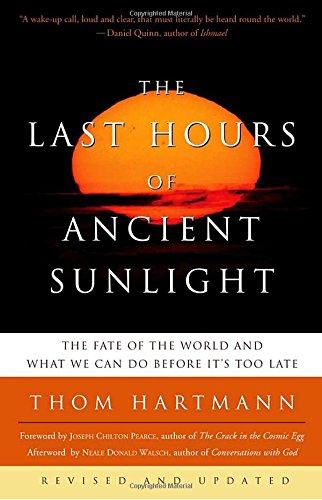
The Last Hours of Ancient Sunlight: Revised and Updated: The Fate of the World and What We Can Do Before It's Too Late, by Thom Hartmann

Fee Download The Last Hours of Ancient Sunlight: Revised and Updated: The Fate of the World and What We Can Do Before It's Too Late, by Thom Hartmann
The Last Hours Of Ancient Sunlight: Revised And Updated: The Fate Of The World And What We Can Do Before It's Too Late, By Thom Hartmann. Let's review! We will certainly frequently figure out this sentence anywhere. When still being a kid, mom used to order us to consistently check out, so did the educator. Some publications The Last Hours Of Ancient Sunlight: Revised And Updated: The Fate Of The World And What We Can Do Before It's Too Late, By Thom Hartmann are totally checked out in a week as well as we need the responsibility to assist reading The Last Hours Of Ancient Sunlight: Revised And Updated: The Fate Of The World And What We Can Do Before It's Too Late, By Thom Hartmann Just what around now? Do you still love reading? Is reviewing just for you which have commitment? Definitely not! We right here offer you a brand-new book entitled The Last Hours Of Ancient Sunlight: Revised And Updated: The Fate Of The World And What We Can Do Before It's Too Late, By Thom Hartmann to check out.
By checking out The Last Hours Of Ancient Sunlight: Revised And Updated: The Fate Of The World And What We Can Do Before It's Too Late, By Thom Hartmann, you could understand the knowledge and also points even more, not just about what you get from people to people. Schedule The Last Hours Of Ancient Sunlight: Revised And Updated: The Fate Of The World And What We Can Do Before It's Too Late, By Thom Hartmann will certainly be a lot more relied on. As this The Last Hours Of Ancient Sunlight: Revised And Updated: The Fate Of The World And What We Can Do Before It's Too Late, By Thom Hartmann, it will truly offer you the smart idea to be effective. It is not just for you to be success in particular life; you can be successful in everything. The success can be begun by understanding the standard expertise and do activities.
From the combo of expertise and also activities, someone can boost their ability as well as capacity. It will lead them to live and work much better. This is why, the students, workers, or even employers need to have reading habit for publications. Any book The Last Hours Of Ancient Sunlight: Revised And Updated: The Fate Of The World And What We Can Do Before It's Too Late, By Thom Hartmann will certainly give certain understanding to take all benefits. This is exactly what this The Last Hours Of Ancient Sunlight: Revised And Updated: The Fate Of The World And What We Can Do Before It's Too Late, By Thom Hartmann informs you. It will include more understanding of you to life as well as function better. The Last Hours Of Ancient Sunlight: Revised And Updated: The Fate Of The World And What We Can Do Before It's Too Late, By Thom Hartmann, Try it and confirm it.
Based upon some encounters of lots of people, it is in reality that reading this The Last Hours Of Ancient Sunlight: Revised And Updated: The Fate Of The World And What We Can Do Before It's Too Late, By Thom Hartmann could help them making far better option and give even more experience. If you wish to be one of them, let's purchase this book The Last Hours Of Ancient Sunlight: Revised And Updated: The Fate Of The World And What We Can Do Before It's Too Late, By Thom Hartmann by downloading and install the book on web link download in this site. You could get the soft data of this book The Last Hours Of Ancient Sunlight: Revised And Updated: The Fate Of The World And What We Can Do Before It's Too Late, By Thom Hartmann to download and deposit in your offered electronic gadgets. Just what are you awaiting? Allow get this book The Last Hours Of Ancient Sunlight: Revised And Updated: The Fate Of The World And What We Can Do Before It's Too Late, By Thom Hartmann on-line and also read them in at any time and also any type of area you will read. It will certainly not encumber you to bring heavy publication The Last Hours Of Ancient Sunlight: Revised And Updated: The Fate Of The World And What We Can Do Before It's Too Late, By Thom Hartmann inside of your bag.
While everything appears to be collapsing around us -- ecodamage, genetic engineering, virulent diseases, the end of cheap oil, water shortages, global famine, wars -- we can still do something about it and create a world that will work for us and for our children’s children. The inspiration for Leonardo DiCaprio’s web movie Global Warning, The Last Hours of Ancient Sunlight details what is happening to our planet, the reasons for our culture’s blind behavior, and how we can fix the problem. Thom Hartmann’s comprehensive book, originally published in 1998, has become one of the fundamental handbooks of the environmental activist movement. Now, with fresh, updated material and a focus on political activism and its effect on corporate behavior, The Last Hours of Ancient Sunlight helps us understand--and heal--our relationship to the world, to each other, and to our natural resources.
- Sales Rank: #30368 in Books
- Brand: Hartmann, Thom
- Model: 961255
- Published on: 2004-04-27
- Released on: 2004-04-27
- Original language: English
- Number of items: 1
- Dimensions: 7.99" h x .87" w x 5.17" l, .64 pounds
- Binding: Paperback
- 400 pages
Review
"One of the most important books you will ever read in your life."
-- Neale Donald Walsch, author of "Conversations with God
"The Last Hours of Ancient Sunlight shines like a beacon in the darkness, an education about reality, a needed wake-up call, and a guidebook through the swamps of denial and ignorance into a brighter, sustainable future."
-- Dan Millman, author of "Way of the Peaceful Warrior and "Everyday Enlightenment
"Thom Hartmann writes one of the most rousing, raging, and right-thinking works of our time."
-- Jean Houston, author of "Jump Time and "A Mythic Life
"Thom Hartmann is one of those people who puts it all together for us, explaining not only what has seriously gone wrong in the world but, even more important, all that can still go right. He is an awakener of the highest order."
-- Marianne Williamson, author of" Healing of America
From the Inside Flap
While everything appears to be collapsing around us -- ecodamage, genetic engineering, virulent diseases, the end of cheap oil, water shortages, global famine, wars -- we can still do something about it and create a world that will work for us and for our children's children. The inspiration for Leonardo DiCaprio's web movie Global Warning, The Last Hours of Ancient Sunlight details what is happening to our planet, the reasons for our culture's blind behavior, and how we can fix the problem. Thom Hartmann's comprehensive book, originally published in 1998, has become one of the fundamental handbooks of the environmental activist movement. Now, with fresh, updated material and a focus on political activism and its effect on corporate behavior, The Last Hours of Ancient Sunlight helps us understand--and heal--our relationship to the world, to each other, and to our natural resources.
Excerpt. � Reprinted by permission. All rights reserved.
We're Running Out of Ancient Sunlight
Where our energy came from, how we're "living beyond our means," and what will happen to our children when we run out
It all starts with sunlight.
Sunlight pours energy on the Earth, and the energy gets converted from one form to another, in an endless cycle of life, death, and renewal. Some of the sunlight got stored underground, which has provided us with a tremendous "savings account" of energy on which we can draw. Our civilization has developed a vast thirst for this energy, as we've built billions and billions of machines large and small that all depend on fuel and electricity.
But our savings are running low, which will most likely make for some very hard times.
In Part I we'll lay out the situation as a foundation for planning our response. Topics in Part I include:
*The history of sunlight in the human story
*How can things look okay yet be so bad?
*The importance of trees--their three vital roles in a renewable environment, and some alarming statistics on what's happening as we cut them down
*The accelerating rate of species extinction as we alter the world and its climate
Let's start at the beginning, with the fuel source that gave life to this planet millions of years ago: sunlight.
We're Made Out of Sunlight
The Sun, the hearth of affection and life, pours burning love on the delighted earth.
--Arthur Rimbaud (1854-1891)
In a very real sense, we're all made out of sunlight.
Sunlight radiating heat, visible light, and ultraviolet light is the source of almost all life on Earth. Everything you see alive around you is there because a plant somewhere was able to capture sunlight and store it. All animals live from these plants, whether directly (as with herbivores) or indirectly (as with carnivores, which eat the herbivores). This is true of mammals, insects, birds, amphibians, reptiles, and bacteria . . . everything living. Every life-form on the surface of this planet is here because a plant was able to gather sunlight and store it, and something else was able to eat that plant and take that sunlight energy in to power its body.
In this way, the abundance or lack of abundance of our human food supply was, until the past few hundred years, largely determined by how much sunlight hit the ground. And for all non-human life- forms on the planet, this is still the case--you can see that many of the areas around the equator that are bathed in sunlight are Wlled with plant and animal life, whereas in the relatively sun-starved polar regions, where sunlight comes in at a thinned-out angle instead of straight-on, there are far fewer living creatures and less diversity among them.
The plant kingdom's method of sunlight storage is quite straightforward. Our atmosphere has billions of tons of carbon in it, most in the form of the gas carbon dioxide, or CO(2). Plants "inhale" this CO(2), and use the energy of sunlight to drive a chemical reaction called photosynthesis in their leaves, which breaks the two atoms of oxygen free from the carbon, producing free carbon (C) and oxygen (O(tm)). The carbon is then used by the plant to manufacture carbohydrates like cellulose and almost all other plant matter--roots, stems, leaves, fruits, and nuts--and the oxygen is "exhaled" as a waste gas by the plant.
Many people I've met believe that plants are made up of soil--that the tree outside your house, for example, is mostly made from the soil in which it grew. That's a common mistake. That tree is mostly made up of one of the gases in our air (carbon dioxide) and water (hydrogen and oxygen). Trees are solidified air and sunlight.
Here's how it works: plant leaves capture sunlight and use that energy to extract carbon as carbon dioxide from the air, combine it with oxygen and hydrogen from water, to form sugars and other complex carbohydrates (carbohydrates are also made of carbon, hydrogen, and oxygen) such as the cellulose that makes up most of the roots, leaves, and trunk.
When you burn wood, the "sunlight energy" is released in the form of light and heat (from the fire). Most of the carbon in the wood reverses the photosynthesis. The small pile of ash you're left with is all the minerals the huge tree had taken from the soil. Everything else was gas from the air: carbon, hydrogen, and oxygen.
Animals, including humans, cannot create tissues directly from sunlight, water, and air, as plants can. Thus the human population of the planet has always been limited by the amount of readily available plant food (and animals-that-eat-plants food). Because of this, from the dawn of humanity (estimated at 200,000 years ago) until about 40,000 years ago, the world probably never held more than about five million human inhabitants. That's fewer people worldwide than live in Detroit today.
I suspect the reason for this low global census is that people in that time ate only wild-growing food. If sunlight fell on a hundred acres of wild lands producing enough food to feed ten people--through edible fruits, vegetables, seeds, and wild animals that ate the plants--then the population density of that forest would stabilize at that level. Studies of all kinds of animal populations show that mammals--including humans--become less fertile and death rates increase when there is not enough food to sustain a local population. This is nature's population control system for every animal species.
Similarly, people's clothing and shelter back then were made out of plants and animal skins which themselves came to life because of "current sunlight," the sunlight that fell on the ground over the few years of their lives. We used the skins of animals and trees to construct clothing and housing.
Extracting more sunlight--from other animals
Something important happened sometime around 40,000 years ago: humans figured out a way to change the patterns of nature so we could get more sunlight/food than other species did. The human food supply was determined by how many deer or rabbits the local forest could support, or the number of edible plants that could be found or grown in good soil. But in areas where the soil was too poor for farming or forest, supporting only scrub brush and grasses, humans discovered that ruminant (grazing) animals like goats, sheep, and cows could eat those plants that we couldn't, and could therefore convert the daily sunlight captured by the scrub and wild plants on that "useless" land into animal flesh, which we could eat. So if we could increase the number of the ruminant animals through herding and domestication, then we could eat more of the recent sunlight they were consuming as grasses and plants. This provided to our ancestors more usable energy, both as work animals and as food animals. And so domestication and herding were born.
Extracting more sunlight--from the land
About this same time in history, we also figured out that we could replace inedible forests with edible crops. Instead of having a plot of land produce only enough food to feed ten people, that same land could now be worked to feed a hundred. The beginning of agriculture is referred to as the Agricultural Revolution, and it began to gather momentum about 10,000 years ago. Because we had discovered and begun to use these two methods (herding and agriculture) to more eficiently convert the sun's energy into human food, our food supply grew. Following the basic laws of nature, because there was more food, there could be more humans, and the human population started growing faster.
Within a few thousand years of that time we also discovered how to extract mineral ores from the Earth, to smelt pure metals from them, and to build tools from these metals. These tools, such as plows and scythes, made us much more productive farmers, so the period from 8,000 b.c. until around the time of Christ saw the human population of the world increase from 5 million people to 250 million people, a number just a bit smaller than the current population of the United States. But we were still only using about one year's worth of sunlight energy per year, and so even though we were eliminating some competing or food species, our impact on the planet remained minimal at worst. We weren't "dipping into our savings" to supply our needs, yet.
Then, as it happened, in the Middle Ages we discovered a new source of sunlight (which had been captured by plants nearly 400 million years ago) that Wt in nicely with our new theory that it was acceptable for humans to destroy our competitors for food, to convert all resources of the planet to the production of food for humans: coal, by replacing forests as a source of heat and thus freeing land for agriculture, could be used to increase our production of food.
When ancient sunlight got stored in the Earth
Around 400 million years ago, there was an era that scientists named the Carboniferous Period. Its name derives from the fact that at the beginning of this period there were huge amounts of carbon in the atmosphere in the form of carbon dioxide. Carbon dioxide is a "greenhouse gas," which holds the heat of the Sun against the Earth like the glass of a greenhouse, rather than letting it escape back out into space. During the Carboniferous Period, which lasted 70 million years and extended from 340 to 410 million years ago, there was so much carbon dioxide in the Earth's atmosphere that the temperature of the planet registered much higher than it does today.
The Earth is about 25 percent land and about 75 percent oceans and at that time the entire planet's land mass consisted of one huge continent, which geologists refer to as Pangaea. This continent existed long before the arrival of birds and mammals, even before the dinosaurs, and the only life-forms on the planet were plants, fish, insects, and small reptiles. The high levels of carbon dioxide in the air both trapped sunlight energy as heat and provided copious carbon for the plants to use as raw material, so they grew abundantly. Almost all of Pangaea was covered with a dense mat of vegetation, rising hundreds of feet into the air, creating a thick ground cover of rotting and dead plant matter that became, in some places, hundreds or even thousands of feet deep. The mats of living and dead vegetation became thicker and thicker as this phase continued over 70 million years.
As the plants grew ever more lush, they trapped more and more of the carbon from the atmosphere (converting it into cellulose as leaves, stems, and roots), reducing levels of atmospheric carbon dioxide while retaining that carbon as plant material.
At the same time, the oceans, which cover three-quarters of the Earth's surface, were also home to huge quantities of plant matter, although much of this was of a simpler type, such as single-celled algae and other microscopic plants. These, too, captured the energy of the sun near the surface of the oceans. They used that energy to convert atmospheric carbon dioxide into plant-matter carbon, and then died and settled on the ocean floor.
Approximately 300 million years ago, a massive disaster occurred and created one of the five historical extinctions that have struck our planet. Nobody knows exactly why (a collision with a comet or asteroid is suspected), but a huge explosion of tectonic activity disassembled the continent of Pangaea and irrevocably changed the planetary environment. The Earth's crust was broken open in many places, volcanoes erupted, and continents crumbled and migrated. In those places where the land masses that were once parts of Pangaea collided with other parts of the former single continent, millions of acres of Earth were covered by mountains or other land. The thick vegetation mat sank underground.
Fifty million years later, the dinosaurs appeared, and another period of relative stability reigned on the Earth and what had become its two major continents, which geologists call Laurasia and Gonwanaland. The Triassic, Jurassic, and Cretaceous Periods (known, together, as the Mesozoic) came to an end 65 million years ago when, according to the most widely accepted scientific view, another meteor or asteroid struck the planet and extinguished the dinosaurs. During the Mesozoic Period, the planet moved into another period of geologic upheaval, and the continents of Laurasia and Gonwanaland broke into smaller parts, creating what we now call Asia, North America, South America, Europe, Australia, Africa, and Antarctica. Mountains were created as continents drifted into each other, and some of the plant matter traveled even deeper into the earth, where it was subjected to great pressure.
Using ancient sunlight
About 900 years ago, humans in Europe and Asia discovered coal below the surface of the Earth and began to burn it. This coal was the surface of most of the ancient mats of vegetation--this 300-million-year-old stored sunlight--and by burning it humans were, for the First time, able to use sunlight energy that had been stored in the distant past. Before this, our ancestors had to maintain a certain acreage of forestland because they needed the wood for heat to survive the cold winters in the northern climates. Forests captured the "current sunlight" energy, and they could liberate that captured sunlight in a fireplace or stove to warm a home, cave, or tipi during the long dark days of winter.
The exploitation of coal, however, reduced their reliance on current sunlight, allowing them to cut more forestland and convert it into cropland, since they no longer were absolutely dependent on the trees for heat. By making more croplands available, they were able to produce more food for more humans, and the population of the world went from 500 million people around the year 1000 to the First billion living humans in 1800.
This represents a critical moment in human history, for this is when our ancestors started living off our planet's sunlight savings.
Because our ancestors could consume sunlight that had been stored by plants millions of years ago, they began for the first time to consume more resources--in food, heat, and other materials--than the daily amount of sunlight falling locally on our planet had historically been able to provide. The planet's human population grew beyond the level that the Earth could sustain if humans were using only local "current sunlight" as an energy and food source.
This meant that if our ancestors' supply of coal had run out, they'd have eventually faced the terrible choice of giving up croplands (risking famine) so they could re-grow forests for heat, or having enough to eat but freezing to death in the winters. (Or, of course, they could have abandoned the colder climates, and packed their population closer together nearer the equator. But the historic movement of people had been away from the equator, a trend encouraged by the availability of fuel.)
Most helpful customer reviews
74 of 78 people found the following review helpful.
Essential impressive reading for mandatory change
By Douglas C. Dutting
I was shocked, entertained, surprised, touched and extremely moved by the contents of this well written eye-opening book. Opposed to other peak-oil subject books this book is not concentrating on the numbers and technical solutions but on our cultural roots and our pathological and illogical behavior as a result. The spiritual part of this book did not bother me at all despite the fact that I don't consider myself as a very spiritual person. I can fully understand his strong arguments to dig into our roots and that we must learn from the point we strayed to the path of superior feeling, materialism, short-term profits, etc... Hartmann delivers his point very well and I recommend this book to all people who think that we can work our way out of this mess we are in by wishfull thinking or technological inventions and to all people who see no way out of it at all (so this are about all people in the industrialized world). We only have to reinvent ourselves and this book shows us the way. Without a doubt one of the top five most important books I have ever read in my life if not the number one. I even think that this book should be read by all children in every school in Europe and America!
0 of 0 people found the following review helpful.
Very eye opening and possibly a catcher for those in the rye.
By Zachary Maneja a thinker of the now and the beyond
This book is an amazing book, mainly for the reason of how eye opening it is. It can be used in almost any situation relating to our lives. I recommend you get many copies of this book and share it. Even if you only get some parts of the book use those some parts of the book. This book has actually made me laugh, think and surprisingly cry. Ive never done that in a book like this. Its an amazing thought. It has opened me to understand that im not the only one who wants others to think mercifully. I thought I was going crazy for talking to the sky the trees and blades of grass and respecting them. Apparently its something we should all do since we are not the only orgamisms on this planet. As a 16 year old ive wondered about many things in life and one of those relates to my main goal as an astrophysiscist ans why I should do it. This book has opened my eyes to understand that whats above us is an amazing thing to see and it opens us to understand the now. I only wish most teens my age would be able open up to the world and focus on the now, how we started etc. Not just what they need but what they enjoy, not only teens but everyone should. One time I was walking home from school and walked down a grassy hill rather than the stairs rjght next to it, a student reminded me that there were stair sright next to the hill so why dont I use it, I explained that I like to walk on what we started with and what we should respect not walk on something that has crushed and ignored it. I would love to explain all my experiences in life and thoughts but I feel its best that you read the book and think about yourself and those around you snd the nature around you.
17 of 18 people found the following review helpful.
A Systems Perspective
By Peter Saflund
Last Hours offers a perspective that is all to often missing from debates about energy, over consumption, waste, and survival. As an engineer type, I find systems thinking, that is, discussions of the inter-relationships and critical dependencies inherent in our lifestyles, almost totally absent from political and business discussions on the energy topic. It's easy to assume we can by some unspecified miracle, easily substitute hydrogen or yet-to-be discovered energy sources to replace oil, and go on as we have before. Hartmann's book explains in an easy-to-understand way why this cannot happen. There are so many great points made in this book it's hard to pick one or two as more praiseworthy than others. However one that many folks may not realize is that the so-called production of oil is not linear - it takes much more time and money to get the last half of the oil out of a well than the first half. For this reason, serious, life-altering planetary shortages will occur long before we 'run out'. People who think we can just substitute nukes would benefit from knowing that it takes at least 12 years to build a plant. Once online, it takes another 17 years for it to pay for itself, and after that it may produce "free" electricity for 3 - 5 years before chemical reactions and radiation make it necessary either to replace major plant components - a process that takes 3-5 years and may cost as much as the whole plant did originally, or retire the plant altogether. (This is not idle theory, it has already happened in the US). Lastly, those who whistle past the graveyard by insisting that the way things are is the way they ought to be (or some higher power would have intervened by now) may benefit from Hartmann's historically accurate account of the way things were before they got to the way they are. For skeptics I suggest that even if Hartmann were half right, you'd be motivated to start taking the important steps now.
See all 146 customer reviews...
The Last Hours of Ancient Sunlight: Revised and Updated: The Fate of the World and What We Can Do Before It's Too Late, by Thom Hartmann PDF
The Last Hours of Ancient Sunlight: Revised and Updated: The Fate of the World and What We Can Do Before It's Too Late, by Thom Hartmann EPub
The Last Hours of Ancient Sunlight: Revised and Updated: The Fate of the World and What We Can Do Before It's Too Late, by Thom Hartmann Doc
The Last Hours of Ancient Sunlight: Revised and Updated: The Fate of the World and What We Can Do Before It's Too Late, by Thom Hartmann iBooks
The Last Hours of Ancient Sunlight: Revised and Updated: The Fate of the World and What We Can Do Before It's Too Late, by Thom Hartmann rtf
The Last Hours of Ancient Sunlight: Revised and Updated: The Fate of the World and What We Can Do Before It's Too Late, by Thom Hartmann Mobipocket
The Last Hours of Ancient Sunlight: Revised and Updated: The Fate of the World and What We Can Do Before It's Too Late, by Thom Hartmann Kindle
The Last Hours of Ancient Sunlight: Revised and Updated: The Fate of the World and What We Can Do Before It's Too Late, by Thom Hartmann PDF
The Last Hours of Ancient Sunlight: Revised and Updated: The Fate of the World and What We Can Do Before It's Too Late, by Thom Hartmann PDF
The Last Hours of Ancient Sunlight: Revised and Updated: The Fate of the World and What We Can Do Before It's Too Late, by Thom Hartmann PDF
The Last Hours of Ancient Sunlight: Revised and Updated: The Fate of the World and What We Can Do Before It's Too Late, by Thom Hartmann PDF